 listicle
5 Best SR&ED Financing Options for 2026
Table of Contents
- Quick Comparison: SR&ED Financing Options for 2026
- How We Evaluated These SR&ED Financing Providers
- 1. Forje Capital: Flexible Bridge Financing for SR&ED Tax Credits
- 2. Boast.ai: Automated Claim Preparation and Non-Dilutive Funding
- 3. Easly: Specialized Cash Advances Against SR&ED Refunds
- 4. Levr.ai: Compare Multiple Lenders for SR&ED-Backed Loans
- 5. GrantOps: Full-Service SR&ED Claim Management and Financing
- SR&ED Financing vs Bank Loan: Which Is Right for Your Business?
- Frequently Asked Questions
Last Updated: September 15, 2026
Quick Comparison: SR&ED Financing Options for 2026
The SR&ED program is Canada's largest tax incentive for research and development (Scientific Research and Experimental Development (SR&ED) tax incentives). Yet the gap between filing a claim and receiving a CRA disbursement can stretch well past a year. That timing gap is exactly why SR&ED financing exists, and why founders at growth-stage companies treat it as a cash flow tool rather than a last resort.
This guide from Forje Capital breaks down the five best SR&ED financing options for 2026, ranked by speed, structure, and fit. We also cover eligibility rules and how to compare non-dilutive capital against a traditional bank loan.
| Provider | Model | Best For | Funding Speed |
|---|---|---|---|
| Forje Capital | Bridge financing | Asset-rich and growth-stage firms | Fast, direct decisions |
| Boast.ai | Claim prep + funding | Tech startups | Weeks |
| Easly | Cash advance | Proven R&D track records | Weeks |
| Levr.ai | Lender marketplace | Comparing multiple offers | Varies by lender |
| GrantOps | Full-service management | Holistic funding strategy | Varies |
How We Evaluated These SR&ED Financing Providers
We scored each provider on five criteria: speed of disbursement, cost of capital, flexibility of repayment terms, depth of claim expertise, and how well the structure preserves equity.
The best option depends on your cash position and your tolerance for dilution, so we weighted flexibility and cost of capital heavily. We also checked whether each provider integrates with provincial credits.
1. Forje Capital: Flexible Bridge Financing for SR&ED Tax Credits
Forje Capital is a private credit provider built for growing Canadian businesses that need capital before the CRA pays out. The pitch is speed and underwriting judgment: decisions rest on operator judgment and the real assets behind your business.

Where it stands apart is the structure. Forje Capital bridges timing gaps for SR&ED and DMTC tax credits, converts unpaid invoices into working capital, and lends against diverse business assets. If you are waiting on a refund and need to cover payroll or equipment now, that flexibility matters.
Pros: Direct access to decision-makers, fast decisions, flexible structures built around business assets and timing. Cons: Pricing depends on your file, so you need to request a quote; it is not a published rate card.
2. Boast.ai: Automated Claim Preparation and Non-Dilutive Funding
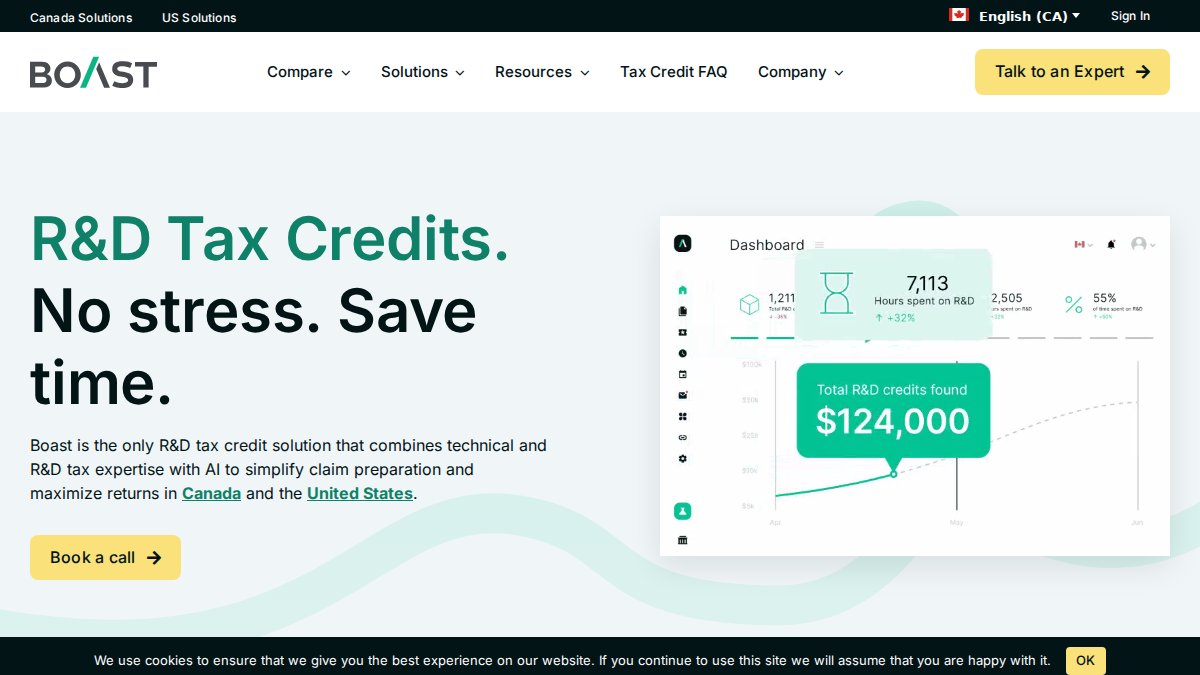
Boast.ai pairs an AI-powered claim platform with integrated financing. It syncs with QuickBooks and Xero, tracks qualifying R&D expenditures in real time, and offers funding before the refund lands.
The strength is accuracy at scale. Automated data synchronization reduces the manual work of assembling a technical report and financial documentation.
3. Easly: Specialized Cash Advances Against SR&ED Refunds
Easly is a specialist, not a generalist. It advances cash against anticipated SR&ED tax credits and does little else, which means its underwriting model is built around one variable: how reliable your refund history is. That focus shows up in repayment terms tied to CRA refund cycles rather than a generic 12- or 24-month amortization schedule.
How the mechanism actually works. You file your SR&ED claim, Easly reviews the technical report and the financial schedules, and it advances a percentage of the expected refund, typically a conservative fraction of the claimed amount, not the full figure. The advance is repaid out of the CRA disbursement when it lands. If the CRA pays less than expected, you cover the shortfall from operating cash. That is the entire risk model, and it is why Easly (like most specialist advance providers) prefers companies with three or more consecutive filed claims and no history of CRA reductions.
Who it fits. Companies with a consistent, well-documented claims history that simply need liquidity between filing and disbursement. The specialization is the point.
Who it does not fit. First-time claimants, companies with a prior claim that was reduced or denied on review, and anyone whose technical documentation is thin. A specialist advance provider has no appetite for unproven refunds, and no amount of relationship management changes that.
The denial-risk question most guides skip. Before signing any advance, ask the provider in writing: what happens if the CRA reduces my claim by 40% on review? The answer should be a clear repayment schedule for the shortfall, not a vague 'we'll work with you.' A common pattern is that the advance is structured so the shortfall becomes a term loan at a higher rate, which is fine if you knew that going in, and painful if you did not.
4. Levr.ai: Compare Multiple Lenders for SR&ED-Backed Loans
Levr.ai is a marketplace. It connects you to a network of alternative and traditional lenders, gives you a dashboard to compare offers, and automates document prep to speed up underwriting.
The obvious benefit is shopping interest rates without calling ten lenders.

5. GrantOps: Full-Service SR&ED Claim Management and Financing
GrantOps blends software with consulting. It manages the full claim, advises on federal and provincial incentives, and provides audit defense support for CRA inquiries.
This is the pick for companies that want a funding strategy, not just a cheque.
SR&ED Financing vs Bank Loan: Which Is Right for Your Business?
This is the decision that actually determines your cost of capital. Here is a framework.
The two cost structures. A bank loan or a crown corporation facility prices on your balance sheet. An SR&ED-backed facility prices on the refund itself. The premium you pay is the price of transferring CRA timing and assessment risk to someone else.
A rough cost-of-capital comparison. Consider a $150,000 refund expected in nine months. A bank facility at prime plus a modest spread might cost a few thousand dollars over that period, but requires collateral and a credit review that can take weeks. An SR&ED advance at a higher effective rate might cost meaningfully more, but it funds in days and does not touch your balance sheet. The question is not which is cheaper in isolation; it is whether the extra cost is less than the cost of the delay. If a payroll gap would stall a development sprint or trigger a key-hire departure, the higher-rate option is the cheaper one.
The contingency-fee trap. Some providers take a percentage of your refund as their fee rather than charging interest. On a small claim this looks cheap. On a large one it is the most expensive capital in the market, because the fee scales with the refund while the work does not. A flat-fee model costs more up front and keeps more of your credit at scale. Run both against your actual claim size before choosing.
Provincial credits change the math. If you operate in a province with its own R&D incentive, stacking the provincial credit on top of the federal one can materially increase the refund you are borrowing against. A financing partner that does not integrate provincial credits is leaving money on the table.
A simple decision rule. If your refund is more than six months away and a cash gap would stall R&D, take the faster, higher-cost facility and size it conservatively. If you can wait and you have assets to pledge, a bank or crown corporation facility will cost less. If you are unsure, ask each provider for the all-in cost over the expected refund period, not the headline rate, and compare that single number.
Eligibility criteria for 2026 remain centered on systematic investigation, technological advancement, and documented eligible work.
Frequently Asked Questions
What are the major changes in the Canadian SR&ED program for 2026?
The SR&ED program emphasizes enhanced documentation and digital submission to streamline the CRA review process.
How does SR&ED financing differ from traditional bank loans?
SR&ED financing uses your anticipated tax credit as collateral, providing non-dilutive capital without giving up equity. Traditional bank loans often require credit history and collateral. SR&ED financing focuses on your R&D activities and expected refund rather than your overall creditworthiness.
What are the eligibility requirements for SR&ED tax credit financing?
To qualify for SR&ED financing, your business must have a valid SR&ED claim or a strong track record of eligible R&D activities. Lenders look for documented qualifying expenditures, a history of successful claims, and a clear timeline for CRA refund. Your company should be in good standing with the CRA and demonstrate the ability to repay the advance once the refund is received. Meeting these criteria can help you secure favorable terms.
How long does it take to receive SR&ED financing?
With specialized providers, SR&ED financing can be approved depending on the completeness of your documentation. The speed depends on how quickly you can provide the necessary financial and technical documentation, and whether you have an established relationship with the lender.
What are common mistakes to avoid when applying for SR&ED financing?
Common mistakes include underestimating your claim amount, failing to document eligible expenditures properly, and waiting too long to apply. Ensure your technical report and financial records are accurate and complete. Avoid over-leveraging by borrowing more than your expected refund. Also, review the terms carefully, especially interest rates and fees, to avoid surprises.
The challenge is rarely eligibility; it is surviving the gap between eligible work and a CRA disbursement. Forje Capital exists for exactly that window, offering bridge financing for SR&ED and DMTC tax credits, accounts receivable financing that converts unpaid invoices into working capital, and flexible borrowing against diverse business assets. If you are waiting on a refund and need capital now, get started with Forje Capital and close the timing gap without giving up equity.